HiTech Structure Illustrator Brushes: Elevating Sci-Fi and Futuristic Design
In the rapidly evolving world of digital illustration, the demand for precision and stylistic consistency is higher than ever. Whether you are designing complex GUI (Graphical User Interface) elements, intricate HUD (Heads-Up Display) overlays, or conceptual sci-fi environments, the tools you choose can significantly impact your workflow efficiency. This is where specialized assets like HiTech Structure Illustrator Brushes become indispensable. These resources are not merely decorative; they are functional components that bridge the gap between rough sketches and polished, professional vector art.
However, many designers, from seasoned professionals to enthusiastic beginners, often overlook the strategic value of dedicated brush libraries. They may attempt to recreate complex technological patterns manually, leading to inconsistent results and wasted hours. Understanding how to properly leverage a bundle that combines Nano technology plexus vector Adobe Illustrator brushes with structural elements can transform your creative process. This guide explores common pitfalls in selecting and using these tools and offers practical advice to ensure you get the most out of your investment.
The Misconception of Manual Precision
A frequent mistake among illustrators working in the sci-fi or scientific genre is the belief that every line and node must be drawn by hand to achieve authenticity. While manual drawing has its place, attempting to replicate the mathematical precision of a plexus network or the uniformity of a circuit board frieze manually is inefficient. The result is often an illustration that looks "off" because human hands struggle to maintain the rigid geometric consistency required for high-tech aesthetics.
By utilizing HiTech Structure Illustrator Brushes, you bypass this limitation. These brushes are engineered to provide endless high-tech ribbons, edging, and structural details that maintain perfect alignment and spacing. The key is recognizing that these tools are not shortcuts that compromise quality; rather, they are precision instruments that enhance it. When you apply a scatter brush designed for nano-technology effects, you are ensuring that every particle and connection point adheres to a cohesive visual language, which is crucial for maintaining immersion in futuristic designs.
Overlooking Compatibility and File Formats
One of the most critical, yet often ignored, aspects of downloading digital assets is verifying compatibility. Many users rush to purchase or download brush packs without checking if they align with their specific version of Adobe Illustrator. A common frustration arises when a user discovers that a brush set requires a newer CC version, while they are still operating on an older CS release. This mismatch can lead to corrupted files, missing features, or complete incompatibility.
To avoid this, always check the technical specifications before making a decision. For instance, the HiTech Structure Illustrator Brushes bundle is designed with versatility in mind. It is compatible with Illustrator CC, but it also includes original AI Illustrator CS and EPS 8 files. This inclusion is a significant advantage, as it allows users across different software generations to access the core assets. Furthermore, having the original files means that if a specific brush does not behave exactly as needed, you can modify it within your own version of Illustrator. This flexibility empowers you to customize the tool to your workflow rather than forcing your workflow to adapt to the tool.
Neglecting Customization Potential
Another prevalent error is treating pre-made brushes as static, unchangeable entities. Designers often apply a brush at its default size, color, and thickness, resulting in artwork that looks generic or templated. This approach fails to leverage the full potential of vector-based brushes. Since these are vector assets, they are infinitely scalable and editable. You should feel encouraged to change the color, size, or thickness of any element to suit your specific project needs.
For example, a ribbon brush intended for a background circuit pattern might need to be thinned down and recolored to a subtle gray to serve as a secondary detail in a HUD interface. Conversely, the same brush could be thickened and brightened to create a primary energy conduit in a sci-fi character design. The ability to manipulate these parameters ensures that your illustrations remain unique. Always experiment with the stroke profile and color settings after applying a brush. This simple step can differentiate a amateur-looking composition from a professional-grade illustration.
Ignoring the Learning Curve and Documentation
Even experienced illustrators can stumble when encountering new brush types, particularly when distinguishing between scatter brushes and pattern brushes. A scatter brush distributes individual objects along a path, ideal for creating debris, particles, or scattered nano-components. A pattern brush, on the other hand, tiles a design along the path, perfect for continuous borders, cables, or structural beams. Misusing these types can lead to disjointed visuals where elements do not connect logically.
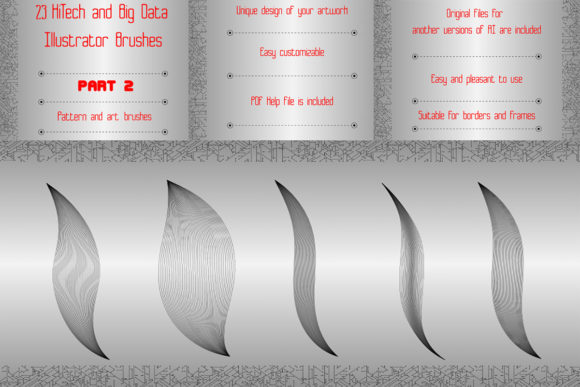
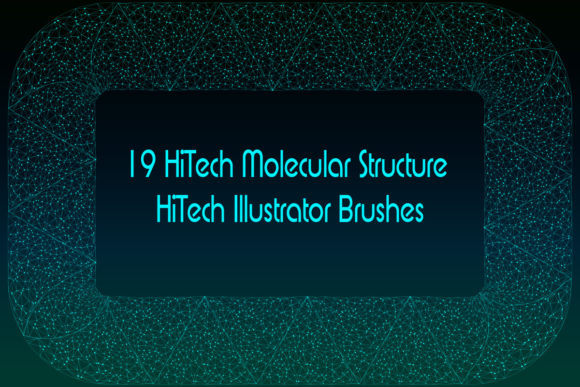
To mitigate this, take advantage of included documentation. The HiTech Structure Illustrator Brushes package includes a PDF help file with screenshots. Many users delete or ignore this file, assuming they can figure it out through trial and error. However, reviewing the guide can save considerable time by clarifying how each of the 19 AI brushes—comprising 14 scatter and 5 pattern brushes—is intended to be used. Understanding the specific behavior of each brush type allows you to combine them effectively, layering scatter elements over pattern structures to create depth and complexity in your GUI or HUD designs.
Evaluating Value Beyond Price
When assessing digital assets, it is easy to focus solely on the price tag while ignoring the scope of the content. A low-cost bundle might seem appealing, but if it lacks variety or technical robustness, it becomes a poor investment. Conversely, a higher-priced pack must justify its cost through versatility and quality. The HiTech Structure Illustrator Brushes bundle offers a comprehensive solution with a ZIP archive size of 18.9 MB, indicating a rich collection of detailed vectors without unnecessary bloat.
Before purchasing, consider the range of applications. Can these brushes be used for both print and web? Are they suitable for both large-scale posters and small icon sets? The inclusion of EPS 8 files suggests a level of backward compatibility and broad utility that adds long-term value. Additionally, the ability to create your own variations from the provided originals extends the lifespan of the product. Instead of buying new brushes for every project, you can adapt existing ones, making this bundle a sustainable addition to your toolkit.
Final Considerations for Smart Adoption
Integrating new tools into your creative pipeline requires a mindful approach. Start by installing the brushes and exploring the PDF guide to understand the distinction between the 14 scatter and 5 pattern brushes. Create a test document where you experiment with changing colors, sizes, and thicknesses to see how the vectors respond. Pay attention to how the nano technology plexus elements interact with structural lines. This hands-on exploration will reveal the true potential of the HiTech Structure Illustrator Brushes.
Remember, the goal is not just to add decoration but to enhance communication through design. Whether you are building a futuristic interface for a game, illustrating a scientific concept for an educational blog, or creating marketing materials for a tech startup, clarity and style are paramount. By avoiding common mistakes such as ignoring compatibility, neglecting customization, and overlooking documentation, you ensure that these tools serve your vision effectively. If you find value in this resource, consider rating it to help other creators make informed decisions. Your feedback contributes to a healthier ecosystem of digital assets, helping fellow designers avoid pitfalls and achieve better results.